
Data protection
Privacy Policy
Introduction and overview
We have written this data protection declaration (version 17.08.2021-111809226) to explain to you which personal data (in short Data) we as the person responsible - and the processors commissioned by us (e.g. providers) - process, will process in the future and what legal options you have. The terms used are gender-neutral.
In short: We provide you with comprehensive information about the data that we process about you.
Data protection declarations usually sound very technical and use legal technical terms. However, this data protection declaration is intended to describe the most important things to you as simply and transparently as possible. As far as transparency is beneficial, technical terms are explained in a reader-friendly way , links to further information and graphics are used. We are thus informing in clear and simple language that we only process personal data in the context of our business activities if there is a corresponding legal basis. This is certainly not possible if you make as brief, unclear and legal-technical statements as possible, as they are often standard on the Internet when it comes to data protection. I hope you find the following explanations interesting and informative and maybe there is one or the other piece of information that you did not know yet.
If you still have questions, we would like to ask you to contact the person responsible named below or in the imprint Place, follow the existing links and view further information on third-party sites. You can of course also find our contact details in the legal notice.
Area of application
This data protection declaration applies to all personal data processed by us in the company and to all personal data processed by companies commissioned by us (contract processors). By personal data we mean information within the meaning of Art. 4 No. 1 GDPR, such as the name, email address and postal address of a person. The processing of personal data ensures that we can offer and invoice our services and products, be it online or offline. The scope of this data protection declaration includes:
- all online presences (websites, online shops) that we operate
- Social media appearances and email communication
- mobile apps for smartphones and other devices
In short: The data protection declaration applies to all areas in which personal data is processed in a structured manner in the company via the channels mentioned. If we enter into legal relationships with you outside of these channels, we will inform you separately if necessary.
Legal bases
In the following data protection declaration, we provide you with transparent information on the legal principles and regulations, i.e. the legal bases of the General Data Protection Regulation, which enable us to process personal data.
As far as EU law is concerned, we refer to REGULATION (EU) 2016/679 OF THE EUROPEAN PARLIAMENT AND OF THE COUNCIL of April 27, 2016. You can of course access this EU General Data Protection Regulation online on EUR-Lex, the access to EU law, at https: // read eur-lex.europa.eu/legal-content/DE/TXT/?uri=celex%3A32016R0679 .
We only process your data if at least one of the following conditions applies:
- Consent (Article 6 Paragraph 1 lit a GDPR): You have given us your consent to process data for a specific purpose . An example would be the storage of the data you entered in a contact form.
- Contract (Article 6 Paragraph 1 lit. b GDPR): We process in order to fulfill a contract or pre-contractual obligations with you Your data. For example, if we conclude a sales contract with you, we need personal information in advance.
- Legal obligation (Article 6 Paragraph 1 lit. c GDPR): If we are subject to a legal obligation, we will process your data. For example, we are legally required to keep invoices for bookkeeping. These usually contain personal data.
- Legitimate interests (Article 6 Paragraph 1 lit. f GDPR): In the case of legitimate interests that do not restrict your basic rights, keep we reserve the right to process personal data. For example, we have to process certain data in order to be able to operate our website securely and economically efficiently. This processing is therefore a legitimate interest.
Further conditions such as the taking of recordings in the public interest and the exercise of official authority as well as the protection of vital interests do not usually arise with us. If such a legal basis should be relevant, it will be shown in the appropriate place.
In addition to the EU regulation, national laws also apply:
- In Austria this is the federal law for the protection of natural persons when processing personal data ( data protection law ), short DSG .
- In Germany the Federal Data Protection Act , in short BDSG . , applies
If further regional or national laws apply, we will inform you about them in the following sections.
Storage period
The fact that we only store personal data for as long as is absolutely necessary for the provision of our services and products is a general criterion for us. This means that we delete personal data as soon as the reason for the data processing no longer exists. In some cases we are legally obliged to store certain data even after the original purpose no longer exists, for example for accounting purposes.
If you want your data to be deleted or if you revoke your consent to data processing, the data will be deleted as soon as possible and unless there is an obligation to store it.
We will inform you below about the specific duration of the respective data processing, provided we have further information.
Rights according to the General Data Protection Regulation
According to Article 13 GDPR, you have the following rights to ensure that data is processed fairly and transparently:
- According to Article 15 GDPR, you have a right to information about whether we are processing your data.If so, you have the right to receive a copy of the data and the following information:
- for what purpose we carry out the processing;
- the categories, i.e. the types of data that are processed;
- who receives this data and, if the data is transmitted to third countries, how security can be guaranteed;
- how long the data will be stored;
- the existence of the right to correction, deletion or restriction of processing and the right to object to processing;
- that you can complain to a supervisory authority (you can find links to these authorities below);
- the origin of the data, if we did not collect it from you;
- whether profiling is carried out, i.e. whether data is automatically evaluated in order to arrive at a personal profile of you
- According to Article 16 GDPR, you have the right to correct the data, which means that we have to correct the data if you find errors. li >
- According to Article 17 GDPR, you have the right to erasure ("right to be forgotten"), which specifically means that you can request the erasure of your data.
- According to Article 18 GDPR, you have the right to restrict processing, which means that we are only allowed to save the data but no longer use it. li>
- According to Article 19 GDPR, you have the right to data portability, which means that we will provide you with your data in a common format on request. li>
- According to Article 21 GDPR, you have a right of objection, which after enforcement results in a change in processing.
- If the processing of your data is based on Article 6 Paragraph 1 Letter e (public interest, exercise of official authority) or Article 6 Paragraph 1 Letter f (legitimate interest), you can object to the processing. We will then check as soon as possible whether we can legally comply with this objection.
- If data is used to operate direct mail, you can object to this type of data processing at any time. We are then no longer allowed to use your data for direct marketing.
- If data is used to operate profiling, you can object to this type of data processing at any time. We are then no longer allowed to use your data for profiling.
- According to Article 22 GDPR, you may have the right not to be subject to a decision based solely on automated processing (e.g. profiling).
In short: You have rights - do not hesitate to contact the person in charge listed above!
If you believe that the processing of your data violates data protection law or your data protection claims have been violated in any other way, you can complain to the supervisory authority.This is the data protection authority for Austria, whose website you can find at https : //www.dsb.gv.at/ find. In Germany there is a data protection officer for each federal state. For more information, you can contact the Federal Commissioner for Data Protection and Freedom of Information (BfDI) . The following local data protection authority is responsible for our company:
Austria data protection authority
Head: Mag. Dr. Andrea Jelinek
Address: Barichgasse 40-42, 1030 Vienna
Telephone number: +43 1 52 152-0
E-mail address : dsb@dsb.gv.at
Website: https://www.dsb.gv.at/
Cookies
| Cookies summary 👥 Affected: Visitors to the website 🤝 Purpose: depending on the respective cookie. More details can be found below or from the manufacturer of the software that sets the cookie. 📓 Processed data: Depending on the cookie used. More details can be found below or from the manufacturer of the software that sets the cookie. 📅 Storage duration: depending on the cookie, can vary from hours to years ⚖️ Legal bases: Art. 6 Para. 1 lit. a GDPR (consent), Art. 6 para. 1 lit.f GDPR (legitimate interests) |
What are cookies?
Our website uses HTTP cookies to store user-specific data.
In the following we explain what cookies are and why they are used, so that you can better understand the following data protection declaration.
Whenever you surf the Internet, you are using a browser. Well-known browsers are, for example, Chrome, Safari, Firefox, Internet Explorer and Microsoft Edge. Most websites save small text files in your browser. These files are called cookies.
One thing cannot be dismissed out of hand: Cookies are really useful little helpers. Almost all websites use cookies. More precisely, they are HTTP cookies, as there are also other cookies for other areas of application. HTTP cookies are small files that our website stores on your computer. These cookie files are automatically placed in the cookie folder, which is the “brain” of your browser. A cookie consists of a name and a value. When defining a cookie, one or more attributes must also be specified.
Cookies store certain user data from you, such as language or personal page settings. When you call up our site again, your browser transmits the "user-related" information back to our site. Thanks to cookies, our website knows who you are and offers you the settings that you are used to. In some browsers each cookie has its own file, in others, such as Firefox, all cookies are stored in a single file.
The following graphic shows a possible interaction between a web browser such as B. Chrome and the web server. The web browser requests a website and receives a cookie back from the server, which the browser uses again as soon as another page is requested.
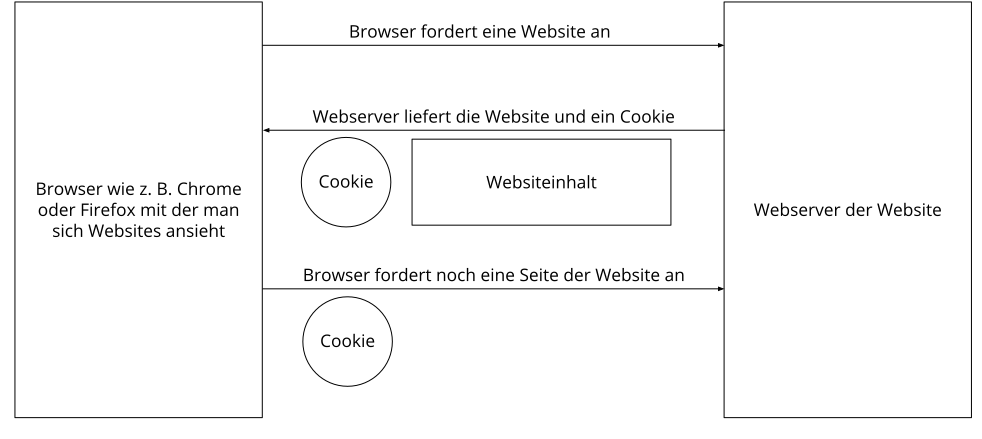
There are both first-party cookies and third-party cookies. First-party cookies are created directly from our side, third-party cookies are created by partner websites (e.g. Google Analytics).Each cookie must be assessed individually, as each cookie stores different data. The expiry time of a cookie varies from a few minutes to a few years. Cookies are not software programs and do not contain viruses, Trojans or other "pests". Cookies cannot access information on your PC either.
This is how cookie data can look like:
Name: _ga
Value: GA1.2.1326744211.152111809226-9
Purpose: Differentiation of website visitors
Expiry date: after 2 years
These minimum sizes should be supported by a browser:
- At least 4096 bytes per cookie
- At least 50 cookies per domain
- At least 3000 cookies in total
What types of cookies are there?
The question of which cookies we specifically use depends on the services used and is clarified in the following sections of the data protection declaration. At this point we would like to briefly discuss the different types of HTTP cookies.
There are 4 types of cookies:
Essential cookies
These cookies are necessary to ensure the basic functions of the website. For example, these cookies are needed when a user puts a product in the shopping cart, then continues surfing on other pages and only goes to checkout later. These cookies do not delete the shopping cart, even if the user closes his browser window.
Appropriate cookies
These cookies collect information about user behavior and whether the user receives any error messages. These cookies are also used to measure the loading time and the behavior of the website with different browsers.
Goal-oriented cookies
These cookies ensure better user-friendliness. For example, entered locations, font sizes or form data are saved.
Advertising cookies
These cookies are also called targeting cookies. They serve to deliver customized advertising to the user. That can be very practical, but also very annoying.
Usually, when you visit a website for the first time, you will be asked which of these types of cookies you would like to allow. And of course this decision is also saved in a cookie.
If you want to know more about cookies and are not afraid of technical documentation, we recommend https://tools.ietf.org/html/rfc6265 , the Request for Comments of the Internet Engineering Task Force (IETF) called “HTTP State Management Mechanism”.
Purpose of processing via cookies
The purpose ultimately depends on the respective cookie. More details can be found below or from the manufacturer of the software that sets the cookie.
Which data are processed?
Cookies are little helpers for a wide variety of tasks. Unfortunately, it is not possible to generalize which data is stored in cookies, but we will inform you about the processed or stored data in the context of the following data protection declaration.
Storage duration of cookies
The storage duration depends on the respective cookie and is further specified under. Some cookies are deleted after less than an hour, others can be stored on a computer for several years.
You also have an influence on the storage duration yourself. You can manually delete all cookies at any time using your browser (see also “Right to object” below).Furthermore, cookies that are based on consent will be deleted at the latest after you withdraw your consent, whereby the legality of storage remains unaffected until then
Right of objection - how can I delete cookies?
You decide for yourself how and whether you want to use cookies. Regardless of which service or website the cookies originate from, you always have the option of deleting, deactivating or only partially accepting cookies. For example, you can block third-party cookies, but allow all other cookies.
If you want to find out which cookies have been stored in your browser, if you want to change or delete cookie settings, you can find this in your browser settings:
Chrome: Delete, activate and manage cookies in Chrome
Safari: Managing cookies and website data with Safari
Firefox: delete cookies to remove data that websites have stored on your computer
Internet Explorer: deleting and managing cookies
Microsoft Edge: deleting and managing cookies
If you generally do not want cookies, you can set up your browser so that it always informs you when a cookie is to be set. For each individual cookie, you can decide whether or not to allow the cookie. The procedure differs depending on the browser. It is best to search for the instructions in Google with the search term “delete cookies Chrome” or “deactivate cookies Chrome” in the case of a Chrome browser.
Legal basis
The so-called "cookie guidelines" have existed since 2009. It states that the storage of cookies requires consent (Article 6 Paragraph 1 lit. a GDPR) from you. Within the EU countries, however, there are still very different reactions to these guidelines. In Austria, however, this directive was implemented in Section 96 (3) of the Telecommunications Act (TKG). In Germany, the cookie guidelines have not been implemented as national law. Instead, this guideline was largely implemented in Section 15 (3) of the Telemedia Act (TMG).
For absolutely necessary cookies, even if you have not given your consent. exist legitimate interests (Article 6 Paragraph 1 lit.f GDPR), which in most cases are of an economic nature. We want to provide visitors to the website with a pleasant user experience and for this certain cookies are often absolutely necessary.
Unless absolutely necessary cookies are used, this will only happen with your consent. The legal basis for this is Article 6 (1) (a) GDPR.
In the following sections you will be informed in more detail about the use of cookies, provided that the software used uses cookies.
Facebook-Pixel data protection declaration
We use the Facebook pixel from Facebook on our website. We have implemented a code for this on our website. The Facebook pixel is an excerpt from JavaScript code that loads a collection of functions with which Facebook can track your user actions if you came to our website via Facebook ads. For example, when you purchase a product on our website, the Facebook pixel is triggered and saves your actions on our website in one or more cookies. These cookies enable Facebook to compare your user data (customer data such as IP address, user ID) with the data in your Facebook account. Then Facebook deletes this data again. The data collected is anonymous and cannot be viewed by us and can only be used in the context of advertising.If you are a Facebook user yourself and are logged in, your visit to our website is automatically assigned to your Facebook user account
We want to show our services and products only to those people who are really interested in them. With the help of Facebook pixels, our advertising measures can be better tailored to your wishes and interests. In this way, Facebook users (provided they have allowed personalized advertising) see appropriate advertising. Furthermore, Facebook uses the collected data for analysis purposes and its own advertisements.
In the following we show you the cookies that were set on a test page by integrating Facebook pixels. Please note that these are only sample cookies. Depending on the interaction on our website, different cookies are set.
Name: _fbp
Value: fb.1.1568287647279.257405483-6111809226-7
Purpose: This cookie uses Facebook to store advertising products
Expiry date: after 3 months
Name: fr
Value: 0aPf312HOS5Pboo2r..Bdeiuf… 1.0.Bdeiuf.
Purpose: This cookie is used so that Facebook -Pixel also works properly.
Expiry date: after 3 months
Name: comment_author_50ae8267e2bdf1253ec1a5769f48e062111809226-3
Value: Name of the author
Purpose: This cookie saves the text and the name of a user, which leaves a comment, for example.
Expiry date: after 12 months
Name: comment_author_url_50ae8267e2bdf1253ec1a5769f48e062
Value: https% 3A% 2F% 2Fwww.testseite…% 2F (URL of the author)
Purpose: This cookie stores the URL of the website, which the user enters in a text field on our website.
Expiry date: after 12 months
Name: comment_author_email_50ae8267e2bdf1253ec1a5769f48e062
Value: Email address of the author
Purpose: This cookie saves the email address of the user, provided he has announced it on the website.
Expiry date: after 12 months
Note: The cookies mentioned above relate to individual user behavior. Changes to Facebook can never be ruled out, especially when using cookies.
If you are logged in to Facebook, you can change your settings for advertisements yourself at https://www.facebook.com/ads/preferences/?entry_product=ad_settings_screen . If you are not a Facebook user, you can basically manage your usage-based online advertising at http://www.youronlinechoices.com/de/praferenzmanagement/ . There you have the option of deactivating or activating providers.
We would like to point out that, in the opinion of the European Court of Justice, there is currently no adequate level of protection for data transfer to the USA. The data processing takes place mainly through Facebook pixels. This can lead to data not being processed and stored anonymously. Furthermore, US government authorities may have access to individual data. It can also happen that this data is linked to data from other Facebook services with which you have a user account.
If you want to learn more about Facebook's data protection, we recommend the company's own data guidelines at https://www.facebook.com/policy.php .
Facebook automatic extended comparison data protection declaration
We have also activated the automatic advanced matching as part of the Facebook pixel function.This function of the pixel enables us to send hashed e-mails, names, gender, city, state, zip code and date of birth or telephone number as additional information to Facebook, provided that you have provided us with this data.This activation still enables us to carry out advertising campaigns on Facebook more precisely to people who are interested in our services or products.
All texts are copyrighted.Source: Created with the data protection generator from AdSimple
.